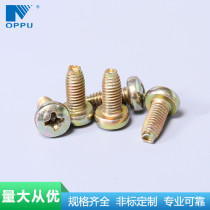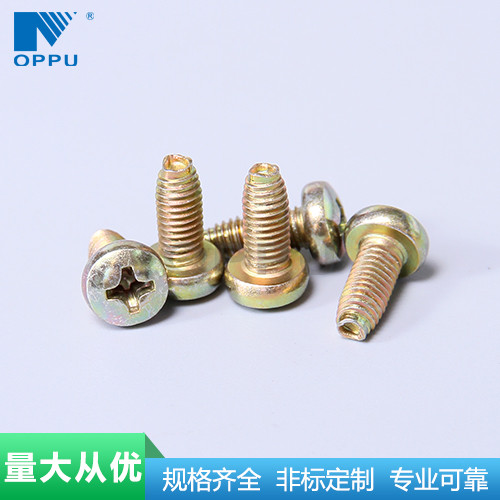
Screws are a common type of fastener, widely used in machinery, electrical appliances, and buildings. Generally, they are made of metal or plastic, cylindrical in shape, and have concave and convex grooves on the surface, which are called threads.
Product Classification:
- Machine Screws
- Self-Tapping Screws
- Self-Drilling Screws
- Wallboard Screws
- Chipboard Screws
- Wood Screws
- Hexagon Head Wood Screws
- Non-Removable Screws
- Combination Screws
- Miniature Screws
- Furniture Screws
- Electronic Screws
- Strip Screws
Surface Treatment Processes of Screws
Types of Surface Treatment: Surface treatment is the process of forming a covering layer on the surface of a workpiece through certain methods. Its purpose is to endow the surface of the product with an aesthetic appearance and anti-corrosion effect. All the surface treatment methods can be summarized into the following types:
- Electroplating: The component to be electroplated is immersed in an aqueous solution containing the metal compound to be deposited. An electric current is passed through the plating solution, causing the electroplated metal to precipitate and deposit on the component. Generally, electroplating includes zinc plating, copper plating, nickel plating, chromium plating, copper-nickel alloy plating, etc. Sometimes, blackening (bluing) and phosphating are also included.
- Hot-Dip Galvanizing: This is completed by immersing carbon steel components in a plating bath of molten zinc at a temperature of approximately 510°C. As a result, the iron-zinc alloy on the surface of the steel parts gradually transforms into passivated zinc on the outer surface of the product. Hot-dip aluminizing is a similar process.
- Mechanical Plating: The surface of the product is impacted by fine particles of the plating metal, and the coating is cold-welded onto the surface of the product.